By Dr. Jarrod Sadulski | 05/22/2026
Note: This blog article is for general informational purposes only and does not constitute advice.
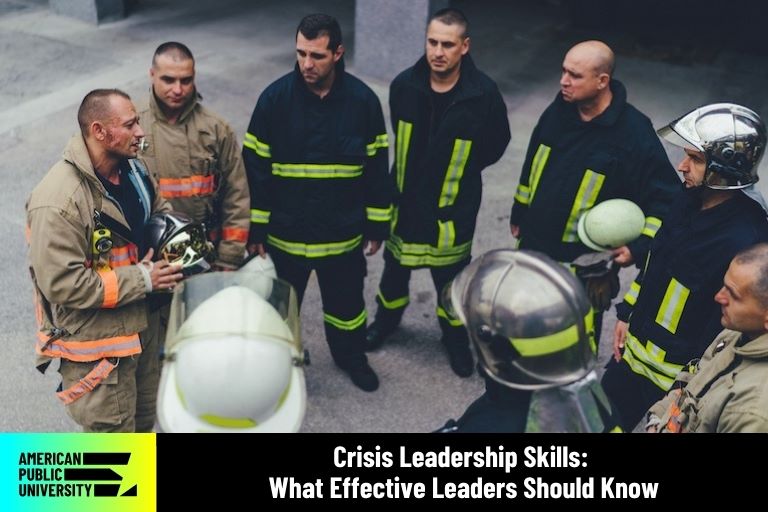
During a traumatic event, crisis leadership skills can mean the difference between life and death. Crisis leadership requires someone involved in a critical incident to apply:
- Critical thinking
- Sound judgment
- Quick thinking
- Prompt action
Crisis response can involve different types of people, including military personnel, police officers, other first responders, and anyone else thrust into a traumatic, possibly dangerous event. Communities and businesses depend on emergency responders to safeguard public safety and health.
Essential Crisis Leadership Skills Every Leader Should Develop
Crisis leadership requires the capability to handle emergencies by developing various skills such as:
- Exercising good judgment
- Remaining calm
- Applying problem-solving skills for effective decision making
- Using emotional intelligence to achieve positive outcomes
- Stabilizing emergency response team members
- Preventing panic and rash decisions based on emotions such as fear
- Projecting strength and clarity of thought
Emotional intelligence is particularly vital for handling a crisis. An ongoing, fast-moving crisis requires leaders to handle many moving parts, so demonstrating empathy and handling any conflicts that arise are crucial.
Common Challenges That Occur During a Crisis
Crisis leaders should focus on helping their subordinates overcome challenges that commonly occur during a crisis, such as tunnel vision and auditory exclusion. For instance, first responders can become hyper-focused on a specific threat or crisis (tunnel vision) that they lose situational awareness. As a result, they miss other threats to themselves and the people they want to rescue.
Auditory exclusion involves subordinates blocking out what they hear (auditory exclusion) during a crisis. Because a threat requires so much attention, it can adversely impact response and recovery efforts.
Early in my police career, I experienced both tunnel vision and auditory exclusion while encountering violent, dangerous 911 calls for service. However, effective leadership can help prepare their subordinates to reduce tunnel vision and auditory exclusion by recommending that they:
- Stay as calm as possible to reduce their heart rates
- Implement controlled breathing
- Use critical thinking to evaluate all information relating to an incident and gain insights
Key Crisis Planning Strategies for Effective Leadership
Crisis leaders commonly handle a wide variety of emergency situations, such as:
- Homeland security or domestic terrorism threats
- Natural disasters
- Active shooter events
- Mass casualty incidents
Strong leaders should mentally prepare themselves and their subordinates to handle emergencies by having a response plan in place. This plan should include a clear definition of each person’s role in the crisis response and a solid communication structure. In crisis management, information should flow up and down the chain of command quickly and efficiently.
Also, leaders must empower others, regardless of rank, to act by equipping them with the knowledge and resources they will need. Strong leaders have the responsibility to lead by example and foster collaboration.
Another responsibility is to anticipate future needs and solutions in critical incident and recovery operations, especially those incidents that could impact public health. Crisis leaders should help their subordinates overcome any challenges associated with the pressure and stress related to new problems and major crises.
Having a clearly defined response plan and solution-driven emergency response strategies aid organizations by fostering a successful outcome to a traumatic event. In addition, being prepared for future incidents can help leaders build confidence within their team.
Crisis Leadership Beyond Senior Roles
Strong leadership does not require that someone always be a high-ranking senior leader who manages a high-performance group of people. For instance, I spent 26 years in the Coast Guard and was involved in hundreds of emergencies. When I responded to these events, I learned how to:
- Evaluate crucial information quickly
- Understand the importance of implementing strategies in real time
- Use critical thinking skills to overcome barriers and meet the immediate needs of people who needed help
Early in my Coast Guard career, I was involved in maritime search and rescue operations. For several years, I worked at one of the busiest search and rescue stations in the country: Coast Guard Station Miami Beach.
After my training, I was designated as a small boat supervisor, responsible for the safe navigation of the vessel and the safety of my Coast Guard crew. As a relatively new leader, I encountered situations that challenged the effectiveness of my skills in responding to a crisis and managing it successfully.
One particular case that comes to mind involved a major collision between two vessels. One vessel was a tour boat carrying a lot of people. As the result of this disaster, people were ejected overboard and we received reports of many injuries.
I had to make split-second decisions based on my ability to process the most up-to-date information I received during this disaster. The situation involved the simultaneous handling of public health concerns, injury triage, and a search for people lost in the water.
Remaining focused on this type of fast-moving situation and maintaining situational awareness are critical skills that are developed over time. For organizations, they are an important part of the leadership job and promote greater success in overcoming adversity during a disaster event.
Mental Health Considerations for Crisis Leaders
Within organizations, everyone processes crises and critical situations differently. Effective leaders should monitor their subordinates for any indicators that a traumatic event has adversely impacted someone’s mental health. These indicators include:
- Nightmares and insomnia
- Anger
- Hypervigilance
- Chronic fatigue
- Difficulty concentrating
- Depression
These problems can be exacerbated when first responders are unsuccessful in saving the lives of disaster victims. To aid employees, organizations can offer mental health support programs, such as an Employee Assistance Program.
Why Effective Training Is Essential for Strong Leadership During a Crisis
To create better leaders, organizations should promote the development of strong leadership skills by offering leadership development training and programs. As a result, first responders will be better equipped to handle the next crisis they encounter.
The Bachelor of Arts in Emergency and Disaster Management at APU
For adult learners who want to study emergency planning, emergency and disaster incident command, and other areas of emergency and disaster management, American Public University (APU) offers an online Bachelor of Arts in Emergency and Disaster Management. For this degree program, students can enroll in courses such as hazard mitigation and preparedness, natural disaster management, and managerial issues in hazardous materials. Other courses include consequence management, risk communications, and the psychology of disaster.
This bachelor’s degree has also received specialty accreditation from the International Fire Service Accreditation Congress (IFSAC®). This specialty accreditation ensures that this academic program has been rigorously examined by higher education professionals to ensure that it meets high academic standards.
To learn more about the B.A. in emergency and disaster management, visit APU’s security and global studies degree program page.
IFSAC is a registered trademark of The Board of Regents for the Oklahoma Agricultural and Mechanical Colleges.
Dr. Jarrod Sadulski is an associate professor in the School of Security and Global Studies and has over 20 years in the field of criminal justice. He holds a bachelor’s degree in criminal justice from Thomas Edison State College, a master’s degree in criminal justice from American Military University, and a Ph.D. in criminal justice from Northcentral University.
His expertise includes training on countering human trafficking, maritime security, mitigating organized crime, and narcotics trafficking trends in Latin America. Jarrod has also testified to both the U.S. Congress and U.S. Senate on human trafficking and child exploitation. He has been recognized by the U.S. Senate as an expert in human trafficking.
Jarrod frequently conducts in-country research and consultant work in Central and South America on human trafficking and current trends in narcotics trafficking. Also, he has a background in business development.