By Marlene Weaver | 12/15/2025
Contemporary leadership scholars, like Warren Bennis and Peter Drucker, have examined the differences between leaders and managers and how these roles shape an organization, its strategy, and their results.
Bennis once said, “Managers do things right. Leaders do the right thing.” Drucker had a similar sentiment: “Management is doing things right; leadership is doing the right things.”
When my students repeat these well-known quotes about leadership and management, I often ask, “So does this mean that managers do not do the right thing and leaders do not do things right?”
My students often don’t have answers to my questions. I like to follow up by explaining that a bank manager may have different day-to-day tasks than a Wing Commander at a Navy base, but both need to plan, act, and motivate people.
Leadership skills are required whenever people are involved. Even Wing Commanders manage meetings and resources, and not all managers are purely administrative – many bring creativity and vision to their teams.
The Various Skills of Leaders and Managers
I contend that all leaders need managerial skills, and all managers need to have leadership skills. Leaders focus on doing things right, and they should do the right things in their day-to-day operations for the organization.
Managers seek to do the right things, and they should also do things right. Good leaders combine strategy, structure, and responsibility with the ability to motivate others – qualities that make both leaders and managers more effective together.
In my course, I reflect on my own experience working at an Air Force Reserve base. For many years throughout my career, I held the position of Budget Officer. I was a manager; I had to manage all the budget issues, all the financial system training and updates, and all the reporting to the entire Wing.
I also had seven employees who directly reported to me. I was so busy every day; I had my head down and worked numbers. My employees knew what to do, and they were all competent.
When employees had a problem, they came to me, and we solved it together. I was friendly and approachable, but I was also focused, task-oriented, and dedicated to getting the job done.
I guided my employees, provided training when needed, and served as a model for a strong work ethic. Although I did not call myself a leader then, looking back, I now see my employees respected me. I balanced both management and leadership to achieve success.
As another example, I was also assigned a special duty. I was required to oversee the deployment process by making sure everything and everyone was accounted for and that safety requirements were followed.
I led a team of about 50 people, and this leader’s job required me to motivate them to be their best for the men and women leaving their families to serve their country. Did I have to manage? Of course.
When problems arose, I solved them so the troops could depart on time. In effect, I managed the managers.
Each area had its own manager and specific processes, and I oversaw the activities, sometimes having to make a few process adjustments. In this case, I felt my job was that of a leader – mostly to motivate the staff to ensure safety and security of our outgoing troops.
That experience showed me how servant leadership works in practice. I led through support, accountability, and care and while also remaining responsible for results.
I would like to think that leaders and managers are all in one. Certainly, bank managers and store managers may be called managers. However, that does not mean they shouldn’t have the leadership skills to lead and motivate the people they manage.
In one position I held during my career, I was labelled Chief of Enterprise Management. When I applied for the job, I didn’t really know what that meant, but I knew I was qualified because the job description mentioned managing all support systems, such as:
- Finances
- Human Resources
- Logistics
- Security
The job description also used the word “lead” several times. The position required me to lead and communicate effectively with all section managers to achieve the goals and ambitions of higher management.
Good Leaders vs. Good Managers: Why Labels Can Distort Perceptions
I contend that there should not be so much emphasis on the differences between leaders and managers, especially when in some cases the title of “manager” is often diminished as if it was inferior to a leader.
I never agreed when Bennis labelled a manager as one who imitates and one who accepts the status quo. Bennis labelled leaders as the people who innovate, ask why and how, and develop original ideas for a company.
In my experience, a good manager can innovate, question, and create new processes, proving that key differences often come down to context rather than capability.
I have known people in leadership positions who can’t even keep their own calendars. They bring their executive assistants to meetings to help them stay on track, and they manage nothing. I have also seen leaders in leadership positions who possess none of the right characteristics to lead or manage a team, so bad things happen.
I have also seen managers who do it all. They have tough jobs with real work and deadlines. They do question the status quo and often offer innovative ideas for their company to improve efficiency.
Naturally, there are managers who are not productive or not respected by their subordinates, but that is a given. Not everyone can inspire people and do a great job. Not all people in management positions are as qualified as they should be.
Hiring Leaders vs. Managers: What to Look For
The hiring officials for a position need to ensure that whoever is selected for the job has the right skills. They cannot overlook leadership ability or emotional intelligence when the job involves supervising others, because those qualities are what make a more effective leader.
Hiring personnel must ensure that leadership skills are present in candidates, especially when those candidates will have direct reports. Personality and leadership assessment tools can help identify whether candidates possess the creativity, accountability, and balance needed to lead people effectively.
It is possible to be an efficient manager who aligns numbers and products. However, if managers do not have the leadership skills to motivate and inspire subordinates to be the best that they can be, they will not be productive.
Great leaders may excel at motivating employees and envisioning new ways of doing business. However, when it comes to organizing a meeting and evaluating reports, they fall behind.
Hiring should focus on people who can merge both strengths. For example, job candidates should demonstrate their ability to think about the big picture, use power responsibly, and understand that structure and planning lead to better performance.
Leadership and Management Involve Overlapping Areas
Leadership and management involve overlapping areas. However, the size of that overlap will vary depending on the job position. It is a rare case where you have one without the other to some degree.
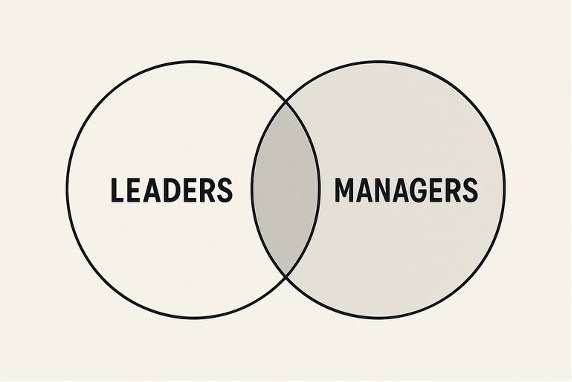
Diagram courtesy of author.
While leaders may focus on people and long-term vision, it is equally important that they achieve the short-term goals of a company by managing affairs at a higher level. Similarly, while managers focus on the bottom line, it is essential that they develop and guide their subordinates with motivation and feedback to be the best.
When both sides work together – leadership and management – the result is greater strategy, organization, and productivity. That is the essence of business management: connecting people, processes, and purpose.
In the end, the difference between leaders and managers is not about separation but synergy. Leaders set the tone, create the vision, and inspire people toward the future. Managers act to plan, organize, and execute those ideas with consistency and precision. Together, they make success happen within any organization.
The Master of Business Administration Degree at APU
For adult learners interested in acquiring the skills to become managers or upskilling, American Public University (APU) offers an online Master of Business Administration. Taught by seasoned business professionals, courses in this MBA program include artificial intelligence practices in business, strategic management, and corporate finance. Other courses involve marketing management, managerial economics, and legal and ethical issues in management.
Students can choose from one of 18 concentrations to ensure that concentration courses meet their professional goals.
This MBA has also received specialty accreditation from the Accreditation Council for Business Schools and Programs (ACBSP®). This accreditation shows that this degree program has been rigorously examined and held high academic standards by professional examiners.
For more information about this MBA, visit APU’s business and management degree program page.
ACBSP is a registered trademark of the Accreditation Council for Business Schools and Programs.