By Dr. Matthew Loux and Bryce Loux | 03/03/2026
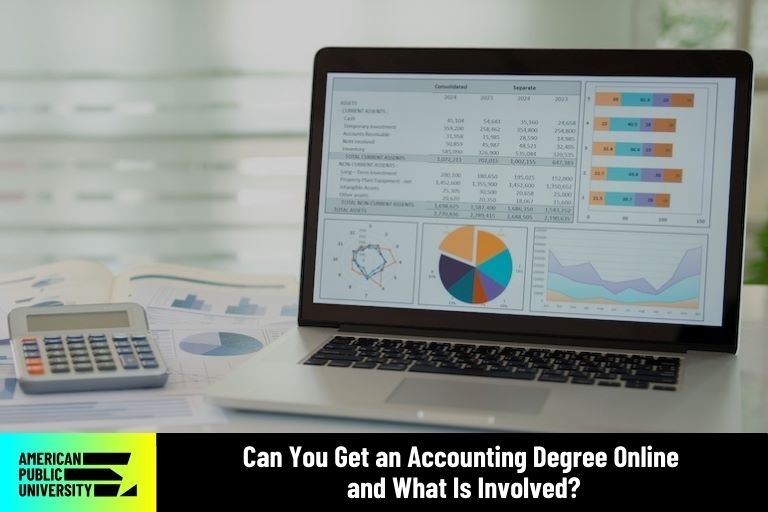
There’s no denying how daunting learning basic accounting can be. Accounting is full of confusing terms like debits, ledgers, balance sheets, and financial statements, and it may be even worse for people who don’t consider themselves good with numbers.
However, the basics of accounting can certainly be learned online. In fact, online accounting courses can be as effective as – or in many cases, more effective – than traditional, classroom-based courses.
Gaining knowledge through an online accounting degree is highly useful. Accounting knowledge supports informed decision-making in areas such as:
- Business
- Law enforcement
- Personal financial planning
What Is Basic Accounting?
Basic accounting is the foundational practice of recording, organizing, and interpreting financial transactions to understand how money flows through an individual, business, or organization. It typically includes:
- Becoming familiar with financial accounting terminology
- Charting events with debits and credits to get a full picture of finances
- Comprehending that assets = liabilities + equity
- Understanding journals and ledgers, as well as the basic principles of accounts payable and accounts receivable
- Knowing the difference between financial and managerial accounting
Knowing accounting also involves preparing and interpreting basic financial reports, such as:
- Income statements, which show revenues and expenses over a period of time and help determine profitability
- Balance sheets, which summarize assets, liabilities, and equity at a specific point in time
- Cash flow statements
Most accounting degree programs also require general education coursework that introduces students to business, communication, and ethics before they choose a specialization.
An accounting degree's courses do not always require advanced mathematics, complicated programs, or professional credentials. Instead, it emphasizes logic, structure, and organization.
The Benefits of Remote Learning
Remote learning allows students to learn accounting concepts through structured, interactive coursework rather than passive instruction. For instance, online accounting degree courses often include:
- Simulation activities
- Self-graded and peer-graded quizzes
- Assignments with instant feedback
These activities can be more effective than passive note-taking because they reinforce accounting concepts through application.
Visual Tools Boost Comprehension
Remote learning emphasizes active engagement by giving students multiple ways to practice and apply accounting concepts. Online accounting degrees often incorporate resources such as:
- Graphs and charts
- Instructional videos
- Examples from real-life scenarios
- Accounting software simulations
These resources assist learners in conceptualizing generally accepted accounting principles like double-entry bookkeeping, which may be too abstract to be captured through traditional textbooks.
Who Benefits from Learning Accounting Online?
Most people assume that learning accounting is exclusively for future finance professionals and accountants. Regardless of the profession or career you pursue, knowledge of accounting is important, and it is relevant to all fields.
Pursuing an accounting major or a concentration in an online program helps to prepare students to pursue specific career paths in accounting, finance, and business. Through specialized coursework, an accounting student may also learn the skills needed to pursue roles such as accountant, auditor, or tax specialist.
Taking online courses for an accounting degree can benefit many groups such as:
- University students
- Working adults and career changers
- Entrepreneurs and small business owners
University Students
No matter which career you pursue, it is vital to understand accounting, especially for:
- Business (especially for corporate finance, cost accounting, capital budgeting, and financial analysis)
- Marketing
- Healthcare administration
- Hospitality
- Entrepreneurship
Online learning provides students with the opportunity to manage their courses within their busy schedules.
Working Adults and Career Changers
Many adults return to school later in life or pursue professional development while working. Individuals balancing work, family, and school appreciate the flexibility online courses offer.
Also, many professionals must regularly interact with financial data and records, including:
- Teachers
- Freelancers
- Project managers
- Nonprofit employees
- Budget managers
Entrepreneurs and Small Business Owners
Business owners and entrepreneurs with a knowledge of accounting can:
- Monitor and manage revenue and costs
- Interpret financial statements
- Understand financial markets
- Collaborate seamlessly with other financial professionals
Understanding accounting can also help many professionals make more informed financial decisions to aid their business and save money.
Can Accounting Be Learned without a Physical Classroom?
A recurring question for many prospective students is: “How can I learn more about accounting without an actual classroom?” Learning accounting without a classroom is possible, but the learning environment and platform must be conducive to learning.
Well-designed online degrees typically include:
- Teaching that is straightforward and uses real-world examples
- Instructors walking through problems step by step
- Students practicing and receiving feedback
- Students having access to instructors and/or online discussion boards
The Challenges of Studying Accounting Online
Online courses present challenges, but these challenges can often be addressed through thoughtful course design and student preparation. These challenges include:
- Students’ concerns about their math skills
- Course support and instructor access
- Study habits and time management
Students’ Concerns about Their Math Skills
Students are often concerned about their math skills, but basic accounting does not require advanced math. Instead, math supports more advanced concepts, usually through organizing and interpreting numerical data.
Overcoming this concern begins with understanding accounting concepts before focusing on calculations. The best online courses clearly explain concepts like why transactions are recorded and how they affect financial statements.
Course Support and Instructor Access in Online Programs
Online courses are more convenience for students, since it’s easier to get in touch with instructors. Online degree courses have:
- Instructors who offer support
- Course discussion boards for exchanging ideas and collaboration
- Recorded Q&A sessions for students to revisit
Study Habits and Time Management for Accounting Courses
Online education requires dedication, regular study habits, and good time management. Ideally, students should develop a study plan, segment lessons into smaller parts, and relate lessons to real-life situations.
Accounting principles are best understood when real-life situations are presented to help students actively practice what they are learning. Examples include situations such as:
- Budgeting for a business
- Creating a financial statement analysis
- Working in sales at a retail store
- Providing accounting services to customers
What to Look for in an Online Accounting Program
Effective online accounting instruction relies on consistent academic support and clear channels for communication. Accounting programs that provide timely instructor feedback, structured opportunities for interaction, and accessible support resources help reinforce accounting concepts and clarify complex material.
Not all online accounting degrees are designed the same way. When researching a program, be sure to:
- Ensure the program comes from an accredited institution (choosing an accredited program is crucial for transferring credits and eligibility for financial aid)
- Review the course syllabus
- Consider online reviews
- Research the platforms used for instruction
- Evaluate the principles or learning objectives
Reviewing the coursework is essential for students to ensure it aligns with career goals. Getting feedback from current and former students can provide valuable insights about an online degree program.
Types of Online Accounting Degree Programs
Online accounting degree programs are designed to meet the needs of students at different stages of their academic and professional journeys. Students who are new to accounting may pursue an online associate degree in accounting, which covers foundational principles of accounting and finance. This associate degree can be a stepping-stone to pursue entry-level positions or a more advanced degree.
Students seeking a broader academic foundation may pursue a bachelor’s degree in accounting. Graduates may earn a Bachelor of Science in Accounting or a Bachelor of Business Administration with an accounting concentration, preparing them to pursue various roles in business and finance.
Students interested in advanced study may pursue a master’s degree in accounting, such as a Master of Accounting (MAC) or a Master of Business Administration (MBA) with an accounting focus. These master’s degree options offer advanced coursework and specialized knowledge.
Accounting Specializations
Depending on their education level and experience, students may pursue roles such as bookkeeper, auditor, treasurer, or budget analyst. Because organizations rely on financial records and reporting, accounting knowledge remains relevant across many industries.
Students with the right type of educational background and experience may choose to specialize. Some types of specialized career paths for accountants include:
- Auditing
- Forensic accounting
- Tax preparation
- Management accounting
- Financial reporting
Earning professional certifications can complement a formal education. These certifications include:
- Certified Public Accountant (CPA)
- Certified Management Accountant (CMA®)
- Certified Fraud Examiner (CFE)
- Certified Forensic Auditor (CFA®)
An Accounting Degree Teaches Transferable Skills
Many transferable skills learned through basic accounting are used in practical, everyday situations. For instance, accounting programs teach students to develop critical thinking, problem-solving, and communication skills. These qualities are highly sought after by many employers.
Basic accounting also provides students with business skills that extend beyond numerical calculations. Accounting includes understanding:
- How businesses function
- How accounting information systems work
- How decisions are made
- How these decisions are represented through numbers
With continued advances in technology, the story that numbers tell can be learned effectively through online platforms as well as traditional classrooms.
The Bachelor of Science in Accounting at APU
For adult learners interested in improving their accounting skills, American Public University (APU) provides an online Bachelor of Science in Accounting. Students who enroll in this degree program can take courses in accounting, business theory, financial management principles, and operations research. Other courses cover topics such as basic productivity applications, advance productivity applications, and the principles and theory of management.
This online bachelor’s degree in accounting has earned specialty accreditation from the Accreditation Council for Business Schools and Programs (ACBSP®). This specialty accreditation ensures that this degree program has undergone rigorous examination and has been held to high academic standards by professional examiners.
For more information, visit APU’s business and management degree program page.
Note: This program is not designed to prepare graduates for any state-issued professional license or certification and therefore has not been approved by any state professional licensing agency. Successful completion may or may not satisfy the educational requirements for the Certified Public Accountant (CPA) exam. Educational requirements for the CPA exam vary by state. Please see your state’s requirements for more information.
Certified Management Accountant is a registered trademark of the Institute of Certified Management Accountants.
Certified Forensic Auditor is a registered trademark of the American Board of Forensic Accounting.
ACBSP is a registered trademark of the Accreditation Council for Business Schools and Programs.
Dr. Matthew Loux is a criminal justice faculty member for the School of Security and Global Studies at American Public University. He holds a bachelor’s degree in criminal justice and a master’s degree in criminal justice administration from the University of Central Missouri State, a doctoral degree in management from Colorado Technical University, and a Ph.D. in educational leadership and administration from Aspen University.
Dr. Loux has been in law enforcement for more than 30 years. He has a background in fraud and criminal investigation, as well as hospital, school, and network security. Dr. Loux has researched and studied law enforcement and security best practices for the past 10 years.
Bryce Loux is an alumnus of American Public University. He holds a bachelor’s degree in fire science with a minor in criminal justice. Bryce is currently a student success coach.