By Dr. Jarrod Sadulski | 01/06/2026
For an offender, prison is typically the last resort. Often, a perpetrator receives jail time when an offense is so egregious that it requires jail time or when a prison alternative such as community service, probation, or diversion programs is unsuccessful. Incarceration also brings justice to crime victims.
However, the vast majority of people who go to prison will not serve the remainder of their lives there. Most offenders serve their time and then re-integrate into society. The hope is that an offender’s time in prison will address the underlying cause of that person’s behavior and rehabilitate the offender so that he or she can become a productive member of society.
In my career which has spanned over 25 years between federal and local law enforcement agencies, I have made countless arrests. Many of those perpetrators were repeat offenders and had been to prison in the past.
As a police officer, I saw the problem of recidivism firsthand. Recidivism is simply the tendency of someone who has been convicted of a crime to commit additional crimes after release from prison. Reoffending is a major risk to public safety, and it’s essential to examine the factors that relate to recidivism and what can be done to mitigate it.
The Recidivism Rate in the US Is Shocking
According to the United States Attorney’s Office, the recidivism rate in the United States is around 70% and 95% of inmates will eventually be released from prison.
Nearly three out of every four people who are released from prison will commit another crime. One study found that 82% of formerly incarcerated individuals were arrested at least one time during the 10 years after their incarceration. Clearly, much more needs to be done regarding reducing recidivism in the criminal justice system.
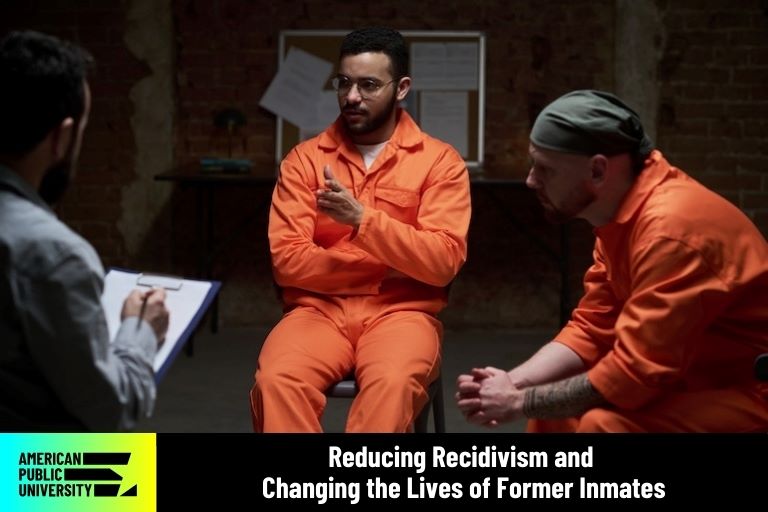
As a humanitarian, I have volunteered a lot of time over the past six years, counseling convicted inmates in prison. I speak with convicted offenders to gain insight into criminality.
I have also counseled hundreds of incarcerated offenders who have been imprisoned in the United States and other countries for various crimes, including:
- Murder
- Drug trafficking
- Arms trafficking
- Robbery
- Human trafficking
This experience of speaking directly with offenders has provided me with considerable insight into criminal behavior, as well as why it occurs and why recidivism is so high. If recidivism rates could be lowered, that has major implications for public safety.
Factors Contributing to Recidivism Among Correctional Populations
In speaking with incarcerated offenders, the most common reason I hear that offenders return to prison is because their underlying issues that led them to prison were not resolved. They also experience a lack of gainful employment once they are released.
Some of these underlying issues may involve undiagnosed mental health disorders, such as:
- Antisocial behavior, including antisocial personality patterns and antisocial cognition
- Cognitive behavioral disorder
As part of a risk and needs assessment, inmates should be screened for mental health issues. If the risk and needs assessment identifies mental health problems, then it is crucial that adequate mental health care is provided to the inmate.
Research has consistently shown that mental health treatment significantly reduces recidivism. Inmates with mental illness can present unique challenges within a correctional facility and will likely need intensive supervision.
Evidence-based programs should be applied to help inmates overcome antisocial personality disorders and other mental health conditions. Otherwise, poor mental health can lead to inmates being a danger to themselves or other people.
The Experience of Former Inmates Who Reoffend
Many offenders have explained to me that they grew up in a broken home with an unstable home life and often without a role model. A lack of accountability during their childhood and early adulthood years is a common theme I hear from inmates.
This lack of accountability has led to collateral consequences, such as engaging in criminal activity from a young age. Many people I have spoken with struggle with anger management, substance abuse, and ethical and moral clarity.
Many offenders dropped out of school at a young age and felt that they did not have any option but to resort to crime. Others I have spoken with felt that they could outsmart law enforcement, and the financial reward of criminal activity was worth the risk of getting caught.
Another common theme I hear is that there is a lack of jobs for convicted felons. The peer pressure created by their associates – such as friends and family members that they associated with prior to incarceration – leads them back to criminal activity. If this type of criminal thinking process is not addressed and resolved through prison rehabilitation, it is likely that more crimes will occur.
Reducing Recidivism Starts in State and Federal Prison Systems
I am a firm believer that reducing recidivism begins with meaningful rehabilitation while an offender is in prison. Based on my experience in speaking with hundreds of inmates, I believe that rehabilitation should begin with providing the services that address the underlying causes of criminality and problem behaviors.
Proper treatment services may include:
- Mental health treatment
- Anger management rehabilitation
- Substance abuse rehabilitation
- Other forms of rehabilitation that addresses the underlying causes leading to criminal activity
Once the treatment services are provided, the next step is to provide inmates with the skills to overcome those challenges. In the case of someone with anger management issues, rehabilitation through proper dispute resolution techniques may be helpful.
Mental Health and Risk and Needs Assessments
Qualified counselors working in justice programs should adequately address any serious mental illness issues that exist as part of an inmate’s rehabilitation. Failure to address any serious mental illness and substance abuse in inmates is dangerous.
A form of rehabilitation that I believe is highly effective is helping convicted offenders see the consequences of their actions. Bringing a panel of community members who speak with convicted offenders about the consequences of their actions to the community and the families of their victims can foster rehabilitation and change.
Another important step in reducing recidivism is providing inmates with trade skills – such as electrical or plumbing knowledge.
This occupational training within correctional facilities should be coupled with useful job skills that can help formerly incarcerated individuals to be employed, such as:
- Problem solving
- Critical thinking
- Time management
- Other organizational skills training
For some justice-involved persons, it may be the first time they receive this type of training. Work-related training can be instrumental in helping former inmates to prepare for life after their incarceration.
Reentry Planning for Released Offenders
Prison education in the corrections system may extend beyond providing trade skills. Inmates may wish to seek a high school diploma or a college degree, which can help them obtain employment and avoid criminal behavior.
Reentry planning is also an important component in reducing recidivism. Returning citizens from prison to the community without a solid reentry plan will likely result in a former inmate going back to prison.
Reentry planning includes the use of transitional housing or residential reentry centers. These structured environments help to prepare former inmates for what they are going to experience in society.
These residential reentry centers commonly offer a supervised environment for someone on parole or probation. That environment promotes independent living skills while ensuring accountability for former inmates through rules and peer support programs.
Transitional centers may also focus on promoting mental health solutions and can address risk factors that may lead someone to reoffending. These centers can also supplement correctional education programs and postsecondary education. Social services should be a part of transitional services.
Nonprofit organizations can also be useful in preventing recidivism. For instance, nonprofit organizations can increase access to services and programs that support reintegration into society.
Nonprofits can also provide access to employment opportunities for former inmates. These organizations can offer services through local jails to address the needs and factors that influence criminal behavior before someone commits a violent crime and enters a state or federal prison system.
Community resources should be implemented to help former inmates with job placement. High- demand fields such as restaurant workers often have labor shortages. Many released offenders can enter that industry with little education, so it is an excellent option for employment.
To avoid adverse outcomes for public safety, the criminal justice system has areas that require improvement. The effectiveness of justice programs at both the state and federal prison system could be improved by increasing mental illness services and other programs offered within the correctional system.
That is a difficult task for most correctional facilities, due to the increasing population and the deteriorating of correctional facilities. Money must be spent to resolve those problems, which decreases the ability to offer services that can help inmates. Ideally, the criminal justice system needs more funding and support for both state and federal prison systems.
The Belize Central Prison Model for Recidivism Reduction
Since 2019, I have led teams to provide the only consistent training that the only prison in Belize receives. What sets this correctional institution apart is that it has one of the lowest recidivism rates in the world at around 10% between three to five years after inmates are released.
What sets the Belize Central Prison apart is that in 2002, a nonprofit organization named the Kolbe Foundation was developed to take over management of the prison due to the deplorable conditions that existed at the time. Prior to the Kolbe Foundation in 2002, the prison had several problems:
- Juvenile inmates were housed with adults.
- The prison lacked a sewage system.
- Crime was rampant in the prison.
- Escapes were common.
Since the Kolbe Foundation took over, the Belize Central Prison has become the model for Central American prisons. As a volunteer with the Kolbe Foundation, I have witnessed the changes firsthand.
The lives of inmates are being changed through meaningful Christian-based rehabilitation programs within the facility led by Kolbe Foundation employees. Inmates who graduate their robust rehabilitation programs receive graduation certificates. They are taught trade skills to help them prepare for life outside of incarceration, which contributes to the prison’s low recidivism rates.
In this correctional facility, Kolbe Foundation volunteers teach various trade skills, including:
- Woodworking
- Electrical training
- Agriculture
- Masonry
- Plumbing
- Computer skills
I have spoken with countless inmates who went through these programs and expressed how it changed their lives. I have also spoken with countless former inmates who said these problems helped to prepare them for release into society and prevented crime.
The Pathway Forward to Reduce Recidivism
Research is needed to evaluate the effectiveness of rehabilitation programs, and randomized controlled trials should be used in this research. Factors such as institutional misconduct and the unique challenges that female inmates experience should be researched to gain a deeper understanding of their influence on recidivism rates.
Ultimately, corrections is an important pillar in the criminal justice system and can have an important role in reducing recidivism risk. When services are offered to present or former inmates, that is essential in promoting public safety, restoring peoples’ lives, and building more resilient communities.
The Bachelor of Arts in Criminal Justice at APU
For students interested in exploring various areas of criminal justice, American Public University (APU) provides an online Bachelor of Arts in Criminal Justice. In this this degree program, adult learners can take courses in U.S. law enforcement, criminology, and ethics in criminal justice. Other courses include criminal investigation, corrections and incarceration, and criminal law.
This bachelor’s degree offers four concentrations, enabling students to choose the courses best suited to their professional goals. These concentrations are:
- General
- Entrepreneurship
- Maritime law enforcement
- Organizational law enforcement leadership
For more details about this bachelor’s degree in criminal justice, visit APU’s security and global studies degree program page.
Note: This degree program is not designed to meet the educational requirements for professional licensure or certification in any country, state, province or other jurisdiction. This program has not been approved by any state professional licensing body and does not lead to any state-issued professional licensure.

Dr. Jarrod Sadulski is an associate professor in the School of Security and Global Studies and has over 20 years in the field of criminal justice. He holds a bachelor’s degree in criminal justice from Thomas Edison State College, a master’s degree in criminal justice from American Military University, and a Ph.D. in criminal justice from Northcentral University.
His expertise includes training on countering human trafficking, maritime security, mitigating organized crime, and narcotics trafficking trends in Latin America. Jarrod has also testified to both the U.S. Congress and U.S. Senate on human trafficking and child exploitation. He has been recognized by the U.S. Senate as an expert in human trafficking.
Jarrod frequently conducts in-country research and consultant work in Central and South America on human trafficking and current trends in narcotics trafficking. He serves as an expert witness in criminology. Jarrod has provided academic presentations across the United States and in Europe, Southeast Asia, and in Latin America on various criminal justice related topics. Also, he has a background in business development.