By Dr. Jarrod Sadulski | 05/12/2026
Note: This article is for general informational purposes only and does not constitute advice. Please consult with law enforcement, legal, and healthcare professionals.
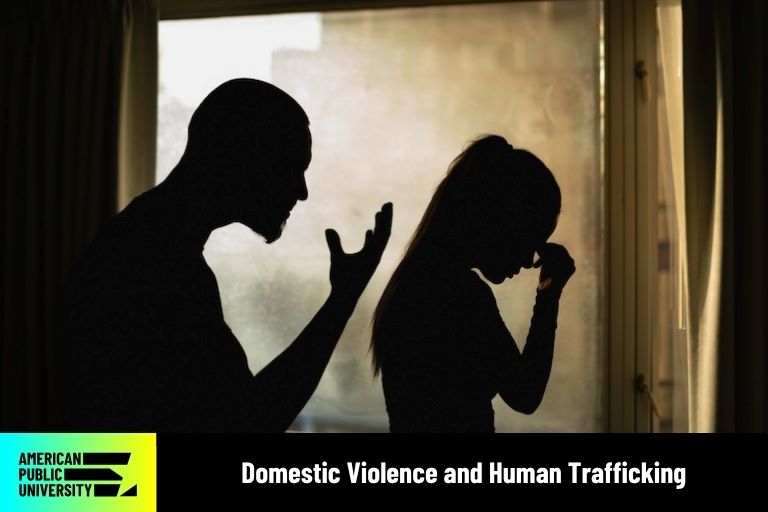
There are many similarities between domestic violence crimes and human trafficking crimes. For instance, the victims of intimate partner violence (also known as domestic violence) and the victims of human trafficking are both controlled by someone else.
In both situations, another person exerts power and control over a victim, often through abusive behavior. This power and control can be exerted over children as well, and children who grow up witnessing volatile situations may experience mental health problems.
Victims of intimate partner violence often experience abusive behavior and coercion in different forms, such as:
- Verbal abuse from the intimate partner
- Physical abuse, including punches, kicks, and sexual assault
- Neglect
- Restricted movement
- Isolation and an inability to communicate with others
Human trafficking survivors are subject to similar abuse and neglect. The power and control exerted over a domestic violence victim is often in the form of threat-based control.
Both types of victims are coerced through violence if they attempt to escape their abuser or trafficker. They may be threatened with their own death or the death or injury of other family members.
Abusers commonly maintain power through the manipulation of others’ emotions. They also maintain control of items that would aid someone trying to escape a violent situation, such as:
- Money
- Identification such as driver’s licenses or passports
- Vehicles or other forms of transportation
- Phones
In addition, victims are often ridiculed and intimidated as a form of power and control, and they are made to feel overly dependent on their abuser. The emotional abuse experienced by both types of victims commonly leads to:
- Mental health issues
- Isolation from loved ones
- Feelings of fear and shame
The Cycle of Abuse in Domestic Violence and Human Trafficking
Abusers typically maintain power by convincing victims that they cannot leave the situation, and any violence and exploitation is the victim’s fault. This form of power and control leads to self-doubt and further forced labor.
In some cases, domestic violence and human trafficking survivors form a bond through trauma. For the victim, repeated exposure to pain and violence leads to an emotional attachment between the abuser and the victim.
In these situations, the mental abuse and physical violence is coupled with intermittent times of peace or affection from the abuser. This behavior results in victims being manipulated into thinking that the abuser cares for them or blaming themselves for the abuse.
Some people minimize the abuser’s behavior by believing that the offender or trafficker will change or that it is too dangerous to leave an abusive situation. They come to accept a continuous cycle of vicious abuse.
In cases of domestic violence and exploitation, survivors may:
- Have injuries at various stages of healing after the violence
- Suffer from depression or chronic illnesses as the result of the abuse
- Cope with physical and mental pain through drug addiction
When Domestic Violence Leads to Human Trafficking
Since control is at the center of both domestic violence and human exploitation, these two areas can overlap. Intimate partner trafficking frequently occurs through the abuser normalizing control, fraud, and coercion of the victim.
In addition to threats, intimate partner traffickers pressure victims into having transactional sex or submit to violent acts with someone outside of the relationship, such as the abuser's friends. The victim may not be aware that the perpetrator receives compensation for these sexual acts and violence, which is considered exploitation.
Throughout my career, I have spoken to many human trafficking survivors and have seen certain similarities. For instance, nearly all of these survivors reported there was a connection to either drug or alcohol abuse with their trafficker. Intimate partners and traffickers frequently encourage victims to become dependent on drugs and alcohol to cope with a violent situation and increase a victim’s compliance.
In the transition from domestic violence to forced labor, some victims receive money from the abuser. In other cases, the victim receives threats of violence to coerce them to endure forced labor or told that they must support the financial survival of the relationship.
In this context, forced labor commonly involves:
- Sex trafficking
- Involuntary servitude (including working as an unpaid nanny)
- Any other form of labor where victims have no choice in what they do
Recruiting More Victims for Human Trafficking
It is also common for traffickers to force their victims to recruit other victims for fraud and involuntary servitude. Trafficking survivors have reported to me that the only way for them to temporarily get out of being trafficked was to locate and recruit other females.
These victim-recruiters target people they believe to be vulnerable. The persons they recruit may have their money stolen, be physically hurt, or be subjected to constant surveillance.
To profit from these persons, traffickers place advertisements online, especially on the dark web. They buy items for the victim (such as revealing clothing) and collect all the proceeds from the forced labor.
Risk Factors for Domestic Violence and Human Trafficking
Persons involved in domestic violence crimes and human trafficking crimes often share common risk factors. These risk factors include:
- A history of child abuse, so that the victim normalizes the violence, power, and control of the abuser
- A lack of family support
- Poverty
- Drug abuse
- Homelessness
Signs of Domestic Violence and Human Trafficking
Trafficking survivors and domestic violence victims commonly report that if law enforcement officers, neighbors, medical personnel, or family members had recognized the signs of violence and abuse, they could have escaped their situation earlier.
There are various signs that indicate someone is a victim of either domestic violence or human trafficking, including:
- Patterns of frequent relocation
- Frequent fighting within a household
- Isolation from other persons, especially friends and family members
- The abuser coaching the victim on what to say or not permitting the victim to speak
- The victim having someone else who exerts total power and control over finances
Children in the household add an additional layer of complexity. For example, abusers may control their adult victims with the threat that their children will be forced into human trafficking.
Law Enforcement Strategies for Domestic Violence and Human Trafficking
Law enforcement is on the front lines to combat domestic violence and exploitation. Police officers should be well versed on the resources and support that is available to victims, such as counseling services and safe houses.
When responding to domestic violence calls, officers should be trained to ask open-ended questions to determine if a domestic violence victim is also a human trafficking survivor. These questions could be:
- Do you have control over your personal belongings and money?
- Are you free to exit your situation?
- Is anyone hurt?
- Are you being forced to work or coerced to isolate yourself from friends and family through any method?
- What issues are you experiencing?
- Has anyone, especially your partner, threatened you or your children unless you perform certain services?
- Does anyone require you to participate in certain acts to protect your children or in exchange for cash or a place to live?
- What methods do you use to receive support for you or your children?
Resources for Domestic Violence and Human Trafficking Victims
The National Human Trafficking Hotline (1-888-373-7888) is a 24/7 service that provides resources and services to survivors of domestic violence and human trafficking, such as:
- Referrals to organizations that can provide different forms of emergency support
- Long-term support to adult victims and their children
The National Human Trafficking Hotline can also be used to report trafficker information.
There is also a National Domestic Violence Hotline. Survivors of domestic violence can obtain support and learn about helpful resources by calling 1-800-799-7233.
The Bachelor of Arts in Criminal Justice at APU
For adult learners interested in learning different areas of criminal justice, American Public University (APU) offers an online Bachelor of Arts in Criminal Justice. Students can enroll courses such as U.S. law enforcement, criminal law, and the criminal legal process. Other courses include criminal profiling, research design and methods, and crime analysis.
To enable adult learners to tailor their education to meet their professional aspirations, this bachelor’s in criminal justice has four concentrations:
- Entrepreneurship
- General
- Organizational law enforcement leadership
- Maritime law enforcement
For more information about the B.A. in criminal justice, visit APU’s security and global studies degree program page.
Note: This degree program is not designed to meet the educational requirements for professional licensure or certification in any country, state, province or other jurisdiction. This program has not been approved by any state professional licensing body and does not lead to any state-issued professional licensure.
Dr. Jarrod Sadulski is an associate professor in the School of Security and Global Studies and has over 20 years in the field of criminal justice. He holds a bachelor’s degree in criminal justice from Thomas Edison State College, a master’s degree in criminal justice from American Military University, and a Ph.D. in criminal justice from Northcentral University.
His expertise includes training on countering human trafficking, maritime security, mitigating organized crime, and narcotics trafficking trends in Latin America. Jarrod has also testified to both the U.S. Congress and U.S. Senate on human trafficking and child exploitation. He has been recognized by the U.S. Senate as an expert in human trafficking.
Jarrod frequently conducts in-country research and consultant work in Central and South America on human trafficking and current trends in narcotics trafficking. Also, he has a background in business development.