By Dr. Jarrod Sadulski | 10/13/2026
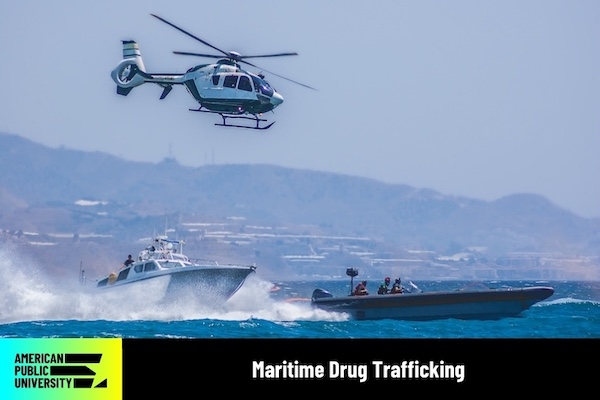
Maritime drug trafficking continues to be a method that transnational criminal organizations use to smuggle illicit drugs into the United States. The routes can vary depending on the type of drug and the source country.
For students and professionals interested in criminal justice, homeland security, law enforcement, or counternarcotics operations, understanding how these trafficking networks operate can provide important context for the challenges authorities face in detecting and disrupting illicit drug shipments.
Examining current and historical trends in maritime narcotics trafficking also shows how trafficking methods, interdiction efforts, and law enforcement responses have evolved over time.
Maritime Drug Trafficking Routes on the High Seas
Drug smugglers commonly use various routes if they are using boats or ships to move drugs. For example, cocaine is typically produced in Colombia, Peru, and Bolivia. Once it is produced and packaged, it is commonly labeled with an insignia or marking that reflects ownership. From there, the cocaine is shipped around the world, often through maritime routes.
Ports in Colombia – such as the Port of Buenaventura on Colombia’s Pacific coast – have long been known by authorities to be major transnational drug shipment points. Commercial vessels that also carry legitimate cargo are often used for drug trafficking.
In some cases, the cocaine and other illicit drugs are concealed inside cargo containers on these commercial vessels. In other cases, the drugs are affixed to the exterior hull of the ship using what are known as parasitic devices. The personnel of a commercial vessel may or may not know about the presence of illicit drugs.
The Challenges of Detecting Maritime Drug Trafficking
Due to the tremendous amount of cargo that is shipped via maritime routes, the detection of illicit drugs is challenging. That challenge is compounded by maritime trafficking routes that cover hundreds of miles of open ocean, making it all too easy to slip drugs through national borders.
While Customs and Border Protection electronically screens cargo manifests and utilizes risk assessments to identify indicators that contraband may be smuggled into the United States, manually inspecting the millions of shipping containers entering ports along the U.S. coast each year is practically impossible.
Efforts to Combat Drug Trafficking in South America
Maritime cocaine routes have continued to evolve internationally. Cocaine produced in South America moves through the Pacific, the Caribbean, and the Atlantic toward markets in North America and Europe.
The Caribbean has historically served as an important transshipment area for Europe-bound cocaine. West Africa and nearby islands have also emerged as transit points for cocaine moving from South America toward European markets.
Drug traffickers exploit any opportunity to move drugs into the United States. While conducting research in Bogotá, Colombia, I had the opportunity to gain insights into specific methods of drug trafficking used to move narcotics from that region to the United States, as well as the efforts to interdict illicit drugs.
Transnational criminal organizations in Colombia have shifted away from the large, centralized drug trafficking cartels of the past, such as the Medellín Cartel and the Cali Cartel. Following the decline of the large Medellín and Cali cartels, hundreds of smaller, decentralized criminal organizations emerged in Colombia to participate in cocaine production and trafficking. In addition to ports in the United States, illicit drugs are commonly shipped to European ports as traffickers seek additional routes and methods to evade detection.
Maritime Drug Trafficking with Narco-Subs
Submarines and semi-submersible vessels are commonly constructed in jungle areas of South America and loaded with large quantities of cocaine for transportation. Due to the low profile of these vessels, their radar signatures can be more difficult to detect than the radar signatures of traditional vessels as they move across the high seas. However, the discovery of narco-subs typically results in large seizures of cocaine.
On both the commercial vessels and pleasure vessels used to transport narcotics, hidden compartments are commonly used to conceal drugs. Drugs concealed in these false compartments require special tools and training to detect.
Some of the common indicators of false compartments that I have seen in my career include:
- Signs of new welding or fiberglass work
- Screws or bolts that are missing or out of place
- Mismatched dimensions inside a vessel that may indicate the presence of a false wall or cavity behind a space
Criminal networks also use go-fast boats (high-performance boats) to ship illicit drugs toward the United States. These boats are typically equipped with several engines and extra fuel containers so that they can move for long distances across the high seas.
The quantities transported on a go-fast boat can be substantial. In one Coast Guard interdiction near the U.S. Virgin Islands, authorities seized more than 200 kilograms of cocaine from a go-fast boat and transferred three suspected smugglers to federal authorities.
Maritime Drug Smuggling in the Caribbean
Illicit drugs that move through the Caribbean corridor may be dropped from airplanes to crews on ships and go-fast vessels that pick up the drugs and transport them to their final destination in the United States. Drugs that are air-dropped may be accompanied by global positioning satellite (GPS) tracking devices to aid smugglers in locating the drugs in the water.
There are also situations where drugs are air-dropped onto remote islands in Central America or the Caribbean. Drugs may be picked up and stored in residences while traffickers determine whether the shipment is being tracked by law enforcement before the drugs are smuggled into the United States.
Close to the coast of Florida, illicit drugs are commonly loaded onto pleasure craft. These boats return to the United States along with legitimate boating traffic, making drug detection more challenging.
Maritime Drug Interdiction and the Coast Guard
The Coast Guard has an essential role in maritime narcotics interdiction. The Coast Guard utilizes technology, modern Coast Guard cutters, and air support to combat drug trafficking operations on the high seas.
The scale of these interdiction efforts can be significant. In 2025, the Coast Guard cutter Stone completed 15 separate interdictions in the Eastern Pacific. These operations resulted in the seizure of more than 49,000 pounds of cocaine, valued by the Coast Guard at more than $362 million.
The Coast Guard also works in close coordination with other law enforcement agencies in the United States and abroad to combat maritime drug trafficking. The United Nations Office on Drugs and Crime also has an active role in combating global narcotics trafficking by providing training and publications on current trends in global narcotics trafficking.
In my career, I have participated in international counternarcotics interdiction operations. I participated in operations on the high seas, in locations such as Florida and the Bahamas, and had the opportunity to seize narcotics being shipped to the United States aboard both commercial vessels and pleasure vessels.
Maritime Drug Trafficking and US Law
U.S. law provides authorities with the jurisdiction to pursue certain drug trafficking offenses beyond U.S. territorial waters. Under the Maritime Drug Law Enforcement Act (MDLEA), federal prohibitions involving controlled substances can apply outside the territorial jurisdiction of the United States when a vessel falls within the jurisdiction established by the law. This prohibition can include stateless vessels operating on the high seas.
As a result, maritime drug interdiction may lead not only to the seizure of evidence and vessels but also to federal prosecution. In recent cases, defendants apprehended aboard vessels in international waters have been prosecuted in the United States for violating the MDLEA. In addition, companies might also be charged according to the “willful blindness” doctrine.
International Cooperation in Maritime Drug Trafficking
When I was in the Coast Guard, one thing that stood out to me the most was the level of surveillance that drug traffickers use while moving illicit drugs into the United States. Spotters were usually positioned along trafficking routes to watch for any signs of law enforcement.
These spotters would use vessels that blended in with regular vessel traffic and/or land-based vantage points. For instance, a person who appeared to be fishing may actually be conducting surveillance for a criminal organization.
Authorities should use more clandestine operations to combat drug trafficking. Advanced technologies that track shipping patterns on the high seas and detect suspicious activity along maritime routes can also support these operations.
Another thing that stood out to me was the importance of intelligence sharing and collaboration among government agencies, both in the United States and abroad. Coordination across jurisdictions is crucial because international investigations and efforts are often necessary to support successful prosecutions and disrupt supply chain operations involving illicit drugs.
Illicit narcotics trafficking will continue to be a problem as long as the strong demand for illicit drugs persists. While interdiction responses continue to evolve through technology and advancements in law enforcement, drug traffickers often have substantial financial resources that allow them to adapt their smuggling methods and continue moving drugs through maritime networks. Consequently, law enforcement agencies will need to cooperate with each other and evolve their strategies to mitigate maritime drug trafficking.
The Bachelor of Arts in Homeland Security at APU
For adult learners who want to improve their knowledge of homeland security, American Public University part of American Public University System (“APU”) provides an online Bachelor of Arts in Homeland Security. For this degree program, students can enroll in various courses, including border and coastal security, critical infrastructure protection, and intelligence and homeland security. Other courses include homeland security legal and ethical issues and research methods in homeland security studies.
This bachelor’s degree has a General concentration that enables students to pick the courses best suited to their professional goals. Examples of these concentration courses include port security, law enforcement intelligence applications, and maritime law.
For more information, visit APU’s homeland security degree program page.
Dr. Jarrod Sadulski is an associate professor in the School of Security and Global Studies and has over 20 years in the field of criminal justice. He holds a bachelor’s degree in criminal justice from Thomas Edison State College, a master’s degree in criminal justice from American Military University, and a Ph.D. in criminal justice from Northcentral University.
His expertise includes training on countering human trafficking, maritime security, mitigating organized crime, and narcotics trafficking trends in Latin America. Jarrod has also testified to both the U.S. Congress and U.S. Senate on human trafficking and child exploitation. He has been recognized by the U.S. Senate as an expert in human trafficking.
Jarrod frequently conducts in-country research and consultant work in Central and South America on human trafficking and current trends in narcotics trafficking. Also, he has a background in business development.