By Dr. Steven Wyre | 08/31/2026
Note: The material contained in this blog article is for informational purposes only and is not to be interpreted as advice.
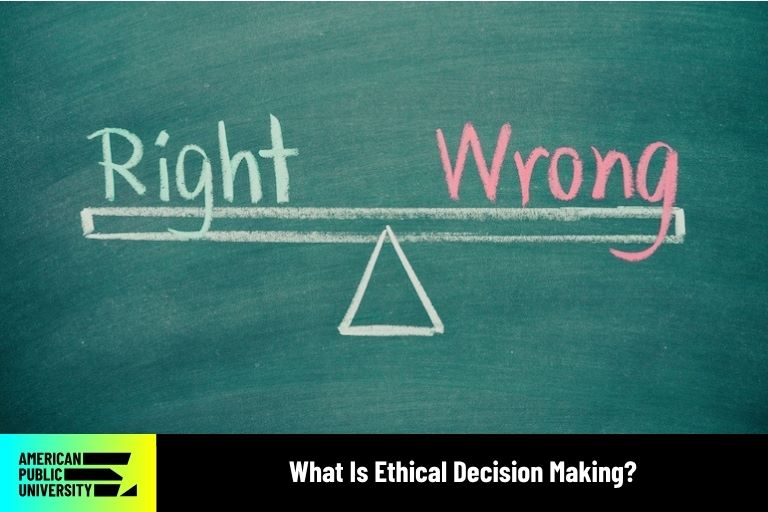
What is the morally right action to take? How should we make ethical decisions?
At first, the answers to these questions seem simple. In many cases, the right answer should be obvious to most rational adults.
Why, then, do we need classes on ethical or moral theories and how to rationalize our justification for taking certain actions? It turns out that rationalizing our justifications is not as clear as seeing the right thing to do.
Understanding Ethical Decision Making
According to ScienceDirect, “Ethical decision making refers to the process of determining the best course of action in situations involving moral or value-based dilemmas, where multiple options may exist and no obvious “right” answer is apparent.”
I have taught ethics courses and ethical decision-making processes for over 25 years. During that time, I’ve observed that it is the justification part where most people go astray in terms of defining ethics and ethical behavior.
I have seen people who were normally considered trustworthy do things that most rational people would find morally wrong, such as:
- Cheating on spouses
- Stealing office supplies
- Lying to students or to me
- Accepting inappropriate gifts
In each case, those unethical people found a way to justify their behavior, at least to themselves. They do what they want and then rationalize it, usually with competing values rather than a moral theory.
Those people think that they deserve to have something in some way or another and have a weak moral compass. They may just want something and do not care about what others might want or need. They ignore mutual respect, fair treatment, or potential consequences.
This way of thinking could be more evidence supporting psychologist Glenn Geher’s view that humans are an irrational species.
Some people may also participate in “ethical fading.” This practice occurs when we put other concerns ahead of morality, rationalizing our behavior as an acceptable means to some desirable end or deceiving ourselves that what we are doing is not so bad.
It is too easy to justify our unethical behavior, especially if it has negative consequences, and assume that no one will be hurt by our deception. Other forms of this type of thinking include:
- No one will find out.
- Everyone else is doing it.
- Business profits vindicate the deception, even the loss of life.
We have all experienced questionable ethical behavior at some time. We’ve been hurt by someone acting unethically or have been surprised that some great person we know could act this way.
Due to cognitive overload, stress, peer pressure, or ambition, the door to acting on unethical principles can swing open just long enough for us to walk in. This behavior is why we need courses on how to think and act ethically.
How Problem-Solving Methods Support Ethical Decision Making
Problem-solving methods are surprisingly similar in every situation where they are taught and used. Lean Six Sigma uses the five-phase philosophy of DMAIC:
- Define
- Measure
- Analyze
- Improve
- Control
Ask any search engine or artificial intelligence (AI) platform about the most effective problem-solving framework, and you will get similar answers. When I asked Microsoft® Copilot® this question, it promoted a six-step process:
- Identify and define the problem clearly.
- Perform a root cause analysis (i.e., asking “5 whys” or using a fishbone diagram)
- Reframe the problem
- Generate solutions creatively (i.e., brainstorming, mind mapping, or reverse thinking)
- Prototype, test, and iterate
- Implement and monitor
Most organizations pitch this process:
- Knowing the facts and building knowledge
- Identifying the required information
- Listing the concerns
- Developing possible resolutions
- Evaluating the resolutions
- Recommending an action
Often, the best way to evaluate options is to use recognized ethical lenses, including utilitarian views, which aim to do the greatest good for the greatest number. This approach emphasizes protecting individuals’ ethical rights.
It is possible to use practical frameworks that help people test their ethical choices before taking action. It’s feasible to channel decisions through frameworks focused on legal or universal values based on:
- The common good
- Fairness
- Religious expectations
How Moral Reasoning Shapes Ethical Decision Making
When applying frameworks to moral or ethical reasoning, certain modifications matter. It is through those modifications that we rationalize ethical solutions.
Ethics entails understanding key principles before we choose a framework or course of action. All credible resources that I have ever read see the first step as identifying a problem.
For ethical decision making, that means ensuring you identify the real ethical issue in a situation. Making ethical decisions about divorce, immunizations, physician-assisted suicide, or the use of AI for schoolwork, for instance, are much different than finding a way to lower costs and increase production on the assembly line.
However, not all ethical conundrums are serious. Deciding to use a sick day to take the family to a movie, telling a small fib about not going to lunch at work, and playing the lottery when you know your significant other hates gambling requires moral reasoning as well.
The point is that unless you correctly identify the issue and what’s at stake, the other steps will not get you where you need to be. Often, we need to discuss potential actions with individuals who see the world and what would be appropriate through a different lens to promote ethical behavior and ensure that you are of good character.
As with all problem-solving methods, there is no magic solution. But by communicating and engaging in open, honest discussion, humans can identify a common justification for the right action to take and what specific rules to follow.
However, there is ample evidence that humans can vigorously disagree about how they see the world and what the right thing to do is. Once a solution is proffered, then you apply it and reflect on the outcome.
Another reality is that humans can make mistakes. For example, we can miss some bit of information, or we can adopt a lens or framework that might not be a good fit for analyzing the problem. We can adopt a solution that does not work or make things worse.
Can AI Improve Ethical Decision Making?
Due to the adoption of artificial intelligence (AI) in many aspects of our society, I wondered if AI could do a better job finding and justifying a solution to an ethical problem. To test this question, I presented two scenarios to three AI tools:
- Gemini® from Google
- ChatGPT® from OpenAI®
- Copilot from Microsoft
For the first analysis, I gave each tool this prompt about ethical behavior: “You are standing behind a woman at a fast-food restaurant who is struggling with a toddler while paying for her order. She drops a $20 bill on the floor but does not notice. It is clear she will walk away without noticing the loss, and no one else is there but you.
“What is the morally right thing for you to do? Explain the reasoning using one to three moral theories.”
In all three cases, these AI tools used utilitarianism, deontology (some duty-based theory), and virtue ethics to analyze the scenario. In each case, these AI tools advised that the right thing to do was to return the money to the woman, discreetly if possible, to avoid any embarrassment.
Utilitarianism aims at the greatest good for the greatest number by weighing consequences, including negative ones, with compassion for stakeholders’ well-being. The rights approach protects individuals’ ethical rights.
Copilot did add one twist to its answer by suggesting that you just ignore the $20 bill. While Copilot said this action would help you avoid responsibility, it also tagged the action as passive wrongdoing.
In the second analysis, I asked all three AI platforms to add a somewhat biased twist I have heard students use in my courses, which they considered legitimate reasoning. The prompt for the second analysis was, “You are standing behind a woman at a fast-food restaurant who is struggling with a toddler while paying for her order. She drops a $20 bill on the floor but does not notice.
“It is clear she will walk away without noticing the loss, and no one else is there but you. You really need the money and had prayed for God to find it for you. What do you do?”
For this second analysis, the answers from each AI tool were longer and more nuanced. ChatGPT found the query interesting because it pitted need, self-interest, and moral responsibility against each other.
Ultimately, the process for each AI tool was the same:
- Finding the facts
- Viewing the situation through various perspectives
- Concluding that even using the “Answered Prayer” argument is faulty and most religious frameworks would promote giving the money back to the woman
Copilot addressed the theological angle by offering that God does not answer prayer by harming others. I liked the way Copilot framed the solution: imagining yourself in the future, retelling the story, and asking whether your action would make you feel proud.
Gemini saw this scenario as pitting personal desperation against empathetic integrity. Copilot then went through various moral lenses or frameworks and concluded that you need to be sure the woman gets her money back.
The common ethical frameworks are also worth considering:
- Deontology stresses duty.
- Virtue ethics favors actions aligned with ideal traits such as honesty and courage.
- Utilitarian reasoning tests which course of action best reflects moral principles, fairness, and ethical choices, rather than profit or convenience.
Ethical Challenges and the Right Course of Action
The steps to ethical decision making are simple: Identify the issue, pick a moral lens through which to view that issue, make a decision, and assess the outcome.
I would like to think that everyone pondering my AI scenarios would see the right thing to do is to be sure the woman gets the money back without conflict or embarrassment. That decision is so simple that even an AI can reach it and find ways to justify it as right.
Reality is usually messier, with confounding variables, disagreements on ethical principles, and divergences on which solutions are the best fit for an ethical challenge. True, effective moral reasoning takes open communication, a grounding in moral principles, and a willingness to discuss the situation with others.
Making ethical choices also means considering fairness and others’ well-being, and compassion can help you identify the ethical course of action. In business settings, ethical behavior establishes trust, prevents a brand's reputation from being destroyed, and positions you to experience success by helping you navigate your conduct.
It’s important to consider: If you are unwilling to discuss an action you want to take with other people, is that action something you ought to do?
The Bachelor of Arts in Philosophy at APU
American Public University (APU) offers an online Bachelor of Arts in Philosophy for interested adult learners who want to study philosophy and ethics. The core covers the history of Western philosophy and allows students to choose from an array of options to complete the degree in 39 credits.
To learn more about this bachelor’s degree in philosophy, visit APU’s arts and humanities degree program page.
Microsoft and Copilot are registered trademarks of Microsoft Corporation.
Gemini and Google are registered trademarks of Google, LLC.
ChatGPT is a registered trademark of OpenAI Opco, LLC.
OpenAI is a registered trademark of OpenAI Foundation.
Dr. Steve Wyre is the Department Chair for Religion, Art, Music, and Philosophy at American Public University. He received his B.A. and M.A. in philosophy from the University of Oklahoma and his Ed.D. from the University of Phoenix. Steve has taught various ground-based philosophy courses since 2000 and online since 2003. He has also served as a subject matter expert (SME) for courses in ancient philosophy, ethics, logic, and several other areas.