By Dr. Aikyna Finch | 12/08/2025
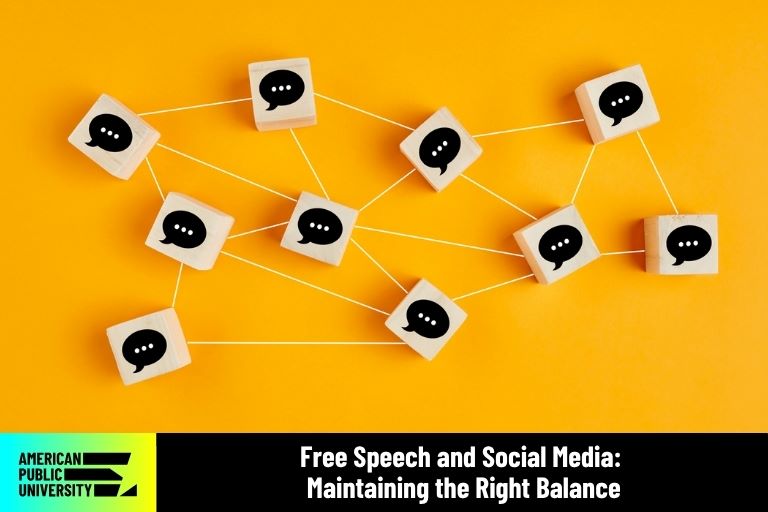
Once upon a time, we expressed our feelings through newspapers, protests hosted by parade organizers, and flyers. Today, that same energy appears in Instagram® stories, TikTok® videos, and Twitter® threads.
The rise of social media platforms and other platforms have given us an unprecedented ability to share our thoughts, connect with others, and organize. However, it has also opened many challenges, including questions about:
- Free speech on the internet
- Privacy
- Accountability
- The blurry line between personal and public expression
- Government action vs. censorship
Now, any citizen can be the primary driver or the target of online discussions through technology. Social media is used to engage in political debates and advocate for change. Similarly, it can be a way to challenge authority and share personal experiences. Every post, like, or comment lasts forever on the internet and can influence reputations, careers, and even campus environments.
While the First Amendment protects our right to speak freely, its meaning has grown more complex in online spaces. There are many debates about:
- Who can speak
- What counts as protected speech
- When social media companies should intervene to moderate content
- When there should be far-reaching consequences to what is said online
- What the government's role should be in content moderation policies
The Influence of Social Media Companies
In today’s world, social media isn’t just a way to stay connected; it’s the central hub of online discourse. Social media platforms like TikTok, Facebook®, Instagram, and X® (formerly Twitter) act as places for activism, discussion, and discovery. Users can use social media sites to share experiences, form communities, and amplify the voices of extremely limited people who might otherwise go unheard.
When the Supreme Court called social networks “the modern public square,” that wasn’t an exaggeration. It is no longer necessary to stand at a podium or write a press release to make an impact; thousands of people can be reached with a 60-second video or a viral hashtag. This digital empowerment has transformed how businesses, universities, government officials, and even the federal government view public expression.
But easy access to what is said on the platforms created by social media companies also exposes us to misinformation, hate speech, and online harassment. The social media platforms that connect us can also divide us, creating echo chambers that reinforce bias and fuel hostility. As a result, the debate about free speech and social media has become much more complex.
The Promise and Peril of Online Speech
Online, a single post can ignite a movement or cause backlash within seconds. The internet gives everyone a voice, but that power can also bring pressure, misunderstanding, and conflict.
Social media blurs the line between personal opinions and public accountability. A post meant to inform or inspire can easily be misunderstood or criticized by strangers. Algorithms often promote loud or controversial content, while quieter and more thoughtful voices struggle to be heard.
Although social media companies claim neutrality, their moderation policies often mirror real-world political and social biases. As a result, how can people speak up and advocate for change on online platforms without the fear of being silenced or misunderstood?
Government Censorship and the Power of Social Media Platforms
Whenever discussions about free speech online arise, the subject of government interference is often nearby. Some people believe that government involvement is necessary to protect digital spaces from abuse and misinformation. Others warn that government censorship might have serious consequences, by silencing valid concerns and limiting expression.
Recently, debates over banning political candidates from social media platforms have intensified. Should a platform have the right to suspend a candidate who spreads misinformation or incites harm? Should voters, not corporations, decide whose voices matter?
Social media companies face increasing pressure from both sides. If they allow everything, they’re accused of fostering extremism. If they use editorial discretion but censor too much, they’re accused of violating First Amendment rights. It’s a delicate balance that affects not only public figures, but also private speakers and regular users.
Content Moderation and Management
Social media platforms process millions of posts every second, including tweets, videos, memes, and comments that influence how people think. To handle this demand, they rely on both human moderators and artificial intelligence (AI).
Content moderation can act as both a shield and a barrier. It eliminates hate-filled speech and misinformation from online platforms, but it can also silence harmless or underrepresented voices. Some courts say platforms have the right to decide what to display, but algorithms often make inconsistent and confusing choices about what gets seen by users.
Some users call for stronger moderation to stop online harassment, while others feel unfairly censored when their posts are removed. Both sides demonstrate the challenges of regulating online speech.
Social media platforms handle billions of user-generated content every day, far too many for perfect moderation. Large companies, such as Meta® and Google®, employ thousands of moderators and utilize AI tools to detect discriminatory language and misinformation.
However, AI isn’t flawless. It often misinterprets humor, activism, or cultural expressions, leading to the mistaken removal of legitimate content.
Search engines encounter similar dilemmas: should they block conspiracy theories or filter hate-filled content? Each choice tests the balance between free speech and corporate responsibility.
Editorial Discretion and Legal Protections
Courts have confirmed that platforms are allowed to select the content they host and have free speech rights. The Fifth Circuit reiterated that requiring media companies to host all viewpoints would violate First Amendment rights.
However, critics argue that giving private companies such power over global communication makes them “gatekeepers” of speech. Social media companies have significant influence over what billions of people see and hear.
Community Standards and Corporate Ethics
To manage the vast challenge of providing information to the public, social media platforms rely on “community standards,” the rules that prohibit hate, violence, and misinformation. But community standards’ enforcement varies; what’s satire in one country might be illegal in another.
Other countries have stricter regulations. Germany’s Network Enforcement Act (the NetzDG law) mandates the quick removal of illegal content under the penalty of facing massive fines., and the EU’s Digital Services Act requires transparency from tech companies. U.S. government regulations, however, emphasize the protection of free speech with fewer legal restrictions, especially in social media contexts.
Algorithms, Authority, and Accountability
Algorithms now determine what content garners attention. These mathematical formulas act like unseen editors, ranking posts that generate clicks and emotional responses, even if that increases social polarization. Although companies claim to be neutral, there are legitimate concerns that algorithmic decisions influence what users see and think and quietly shape public opinion.
Users, educators and policymakers are demanding greater transparency. Universities are instructing students to:
- Question digital authorities
- Analyze algorithms
- Understand how online systems influence their worldview
The Evolving Ethics of Expression
Free speech in the digital age isn’t just about who gets to speak; it’s about who gets heard, how truth is established, and who makes the decisions.
This situation offers both empowerment and vulnerability. Users are creators, curators, and critics all at once. However, with algorithms favoring outrage and virality over nuance, the most engaging posts can also divide societies.
Digital citizenship is now an essential skill, and users need to know not just how to communicate, but how to communicate effectively. Digital literacy programs increasingly examine the moral implications of posting, sharing, and commenting.
These lessons go beyond “think before you post” and pose larger questions:
- What is truth in a world of deepfakes?
- How do you practice empathy in a comment thread?
Cancel Culture and Consequences
The phrase “cancel culture” has become a shorthand for what happens when public opinion turns into digital punishment. For some people, it’s accountability and society collectively rejecting harmful behavior. For others, it’s censorship, silencing dissent through social pressure and sometimes government intervention.
Digital platforms have amplified marginalized voices and held the powerful accountable, but they have also magnified mob behavior and removed nuance from public debate. The same tools that helped launch social justice movements can also ruin reputations in an instant.
Free Speech, Privacy, and the Data Dilemma
Every tweet, selfie, and video on the internet serves as personal data that can be stored, sold, or monitored. Users now face a paradox: they need to share information to be acknowledged, yet sharing makes them vulnerable. Tech companies promise connection while secretly gathering the digital footprints of an entire generation.
Should privacy be considered a modern extension of free speech, a right to control one’s digital identity? If speech is free but surveillance is ongoing, can expression truly be free? These issues are real, not just hypothetical debates. Employers, universities, businesses, and governments already monitor social media to assess behavior and loyalty.
Reimagining Digital Freedom
To safeguard free expression, it is necessary to redefine what digital freedom entails. It’s not just about the right to speak but also the right to exist online free from manipulation, harassment, or exploitation.
Freedom should shift from mere protection to active practice. It should encompass the creation of inclusive digital spaces, the demand for algorithmic transparency, and advocacy for responsible AI.
True online freedom needs courage and curiosity. It involves:
- Avoiding echo chambers
- Engaging with those people who have different views
- Questioning who gains when we speak or remain silent
Global Perspectives on Free Speech
Travel the world and you’ll quickly see how differently countries handle online speech. Some governments control the media entirely, preventing citizens from expressing themselves freely online. Others have stricter laws against discriminatory speech and misinformation, which are much more stringent than those laws in the U.S.
In America, the First Amendment continues to protect free expression in ways that many people around the world can’t even imagine. However, that freedom carries responsibility, especially for public figures and government officials. What we post, tweet, or share can have a significant impact on others, so it’s crucial to think carefully before hitting “share.”
Across the world, people utilize social media to highlight injustices and advocate for change. In some countries, this kind of online activism can result in arrest or worse. This contrast reminds us of the value of free speech and the importance of defending it.
The Human Side of Digital Expression
A person makes every trending hashtag or viral video, who takes the chance to press “post.” That moment of sharing can feel both freeing and frightening.
The digital world amplifies every voice, but it also amplifies every mistake. A sentence written in frustration, a joke taken out of context, or a political opinion shared without nuance can follow you for years, shaping not just how others see you but also your opportunities.
That’s the new frontier of free speech: permanence. Once something is said online, it rarely disappears.
Screenshots outlast apologies, and algorithms don’t forgive. This reality forces people to navigate their identities in public view, a challenge no previous generation has faced so intensely.
Still, social media provides power that were only mere dreams for previous generations. Users are launching awareness campaigns, creating online communities for mental health, and leading protests on the internet that start with a single post and spread worldwide.
When students from Parkland, Florida, turned their grief into activism through the #MarchForOurLives movement, they redefined what civic engagement looks like in the 21st century. That’s the dual edge of digital speech; it can destroy, but it can also transform.
Digital Dialogue and the New Rules of Respect
Free speech in online spaces now requires digital empathy. Words move faster than thoughts, and outrage spreads more quickly than truth.
Learning how to participate in digital dialogue – how to listen, question, and respond thoughtfully – is as vital as earning any degree. Online speech isn’t just about freedom of speech; it’s about building relationships. Every post serves as a means of communication that shapes communities, influences peers, and reflects shared values.
Ultimately, free speech isn’t a fixed right; it’s a dynamic practice and has been tested by various Supreme Court rulings. It thrives when people engage with purpose, not just passion.
The future of free speech hinges not only on laws and platforms, but also on our habits of thought and cultural norms. Will we choose to share responsibly, debate respectfully, and listen deeply while adhering to our First Amendment rights? Will we develop technologies that protect both truth, tolerance, and our right to free expression?
The Power of Thoughtful Expression
Social media isn’t disappearing, it’s transforming. The next wave of platforms, driven by artificial intelligence and decentralized structures, will challenge our collective maturity. We’ll need to ask who creates these systems, what values they embody, and what kind of digital society we want to build.
Freedom of speech, at its best, isn’t about noise; it’s about having a voice to speak truth, challenge injustice, and foster understanding. It isn’t just a constitutional right; it’s a moral calling.
The internet reflects humanity, which is messy, beautiful, and unfinished. How we use that reflection will shape our era. Whether through hashtags, viral videos or thoughtful essays, the next chapter of democracy will be written by users brave enough to speak and wise enough to listen.
Teaching Digital Responsibility
Colleges play a vital role in teaching digital responsibility. Through courses on media literacy, digital ethics, and civic engagement, students learn how algorithms, privacy, and online culture influence public life.
Today’s students aren’t just users, they’re future leaders. How they use their digital voices will shape the next chapter of democracy.
The Future of Free Speech and Social Media
The future of free speech online relies on users. Artificial intelligence already influences what we see in search results and what gets removed by content moderation. New decentralized platforms offer more freedom and less corporate control, but they could also become fragmented and complex to access.
There’s an increasing debate over Section 230, the law shielding social media companies from lawsuits over user posts. If it’s amended, large platforms might adjust, but smaller ones could get left behind.
The real challenge is finding a balance. There should be established community standards that safeguard individuals without silencing them and regulations that stop abuse without veering into censorship.
Free speech rights are not just an abstract constitutional idea, but an authentic experience. Social media platforms are now classrooms, stages, and battlegrounds all at once.
But with that freedom comes the responsibility to think critically, listen compassionately, and speak with integrity. Ultimately, the story of free speech and social media isn’t about laws or algorithms. It’s about people finding their voices in a noisy world and learning how to use those voices wisely.
The Bachelor of Arts in Communication at APU
For adult learners interested in improving their communication skills and knowledge, American Public University (APU) provides an online Bachelor of Arts in Communication. For this degree, students will study communication topics such as social media and society, public speaking, and intercultural communication. Other courses include mass communication, ethics in communication, and communication theory.
This course features two concentrations so that students can choose the courses best suited to their professional interests:
- Digital communications and media design
- Strategic communication
For more information about this bachelor’s degree in communication, visit APU’s arts and humanities degree program page.
Instagram is a registered trademark of Instagram, LLC.
TikTok is a registered trademark of TikTok, Ltd.
Twitter is a registered trademark of the X Corporation.
Facebook is a registered trademark of Meta Platforms, Inc.
X is a registered trademark of the X Corporation.
Meta is a registered trademark of Meta Platforms, Inc.
Google is a registered trademark of Google, LLC.