Online Master of Public Health (MPH)
Examine the public health practices that support healthy communities and promote wellness within our diverse global environment. This MPH program at American Public University (APU) engages students through hands-on research and explores emerging public health challenges. APU’s CEPH-accredited program also explores emergency and disaster management protocols, and learners obtain several FEMA certificates through required coursework.

Program Overview
Develop a deep understanding of the scientific, psychological, and sociological elements that impact public health policy and practices. This Master of Public Health prepares students to address today’s most pressing public health challenges.
American Public University’s program is accredited by the Council on Education for Public Health (CEPH®)1. Students develop solutions to address community and global health issues as they discuss health policy and management. Courses cover a range of subject areas that include biostatistics, environmental health sciences, and social and behavioral sciences.
Learners complete hands-on research while they consider the importance of public health advocacy. The public health practicum also provides real-world experience in the field. APU’s interdisciplinary curriculum focuses on emergency and disaster management to prepare students with career-relevant leadership skills. Students complete the program with several FEMA-issued certificates.
Courses are led by faculty members with real-world experience in public health, as well as public- and private-sector organizations. These educators all hold doctoral degrees in their respective fields.
NOTE: This program has special admission requirements.
With a focus on emergency and disaster management, this online MPH program equips students with career-relevant skills. Graduates demonstrate the ability to navigate various public health issues, and they complete the program with several FEMA-issued certificates.
APU’s curriculum also helps learners prepare to pursue the Certified in Public Health (CPH) credential. Coursework explores the key concepts covered in the CPH exam administered separately by the National Board of Public Health Examiners.

The Council on Education for Public Health (CEPH®) is an independent agency established to accredit schools of public health, and public health programs outside schools of public health.
The Master of Public Health program at American Public University part of American Public University System is accredited by CEPH through December 31, 2029.
CEPH® is a registered trademark of the Council on Education for Public Health.
Gain the Knowledge and Skills to Address Today’s Global Health Challenges
APU’s online MPH program provides a career-relevant education through coursework that immerses students in the public health field. Assignments integrate simulated emergency scenarios to prepare learners to navigate real-world public health crises.
Students also have opportunities to engage in hands-on research, contribute to peer-reviewed journals, and present their findings through webinars. In addition, the program incorporates digital volunteering opportunities, through which MPH students prepare social media content and blog posts to engage with communities online.
This online Master of Public Health program provides students with a strong foundation in data analysis, policy development, and community engagement. Core courses emphasize evidence-based decision-making and learners discuss how public health leaders operate within local, national, and global health systems.
Students will also:
- Evaluate screening methods of epidemiology using statistical analysis and the impact of disease occurrence, both past and present, on population health
- Evaluate the effects of environmental factors on the health of populations and discuss appropriate policies to prevent and manage environmental hazards
- Apply emergency preparedness and disaster health management to public health and healthcare settings
- Analyze health policies or regulatory systems to address the management of population health
- Develop programs and/or interventions that effectively address the social determinants of health and health disparities
Courses explore how public health professionals analyze data, implement policies, and engage their communities. Students learn to lead and evaluate health promotion initiatives as they discuss the nuances of emergency and disaster management. This advanced degree also prepares learners to address emerging public health threats and advance health equity.
Graduates may have potential career opportunities as:
- Epidemiologists/public health analysts, who design and conduct studies, analyze surveillance data, and advise leaders on interventions and policy options to protect population health
- Medical and health services managers, who plan and direct programs, manage budgets and staffing, and leads quality improvement initiatives for public health and/or community health organizations
- Environmental health specialists, who assess environmental and occupational risks and inspect facilities to enforce compliance standards
- Health education specialists/community health coordinators, who develop and evaluate health-promotion programs, create culturally appropriate materials, and assess intervention outcomes
- Biostatisticians/health data analysts, who apply statistical modeling to clinical and public health datasets and build reports that guide policy and operational decisions
APU’s MPH program prepares students to address complex global health issues through coursework that examines how research influences public health programs and policies. Learners build data analysis skills as they discuss how to promote health equity across diverse populations. Courses explore leadership strategies for engaging cross-cultural communities, and students consider myriad ethical issues that arise within the public health field.
As learners progress through this online program, they’ll develop the ability to:
- Apply epidemiologic methods to investigate population health issues and provide actionable insights
- Analyze public health data using descriptive and inferential statistics, and translate findings into dashboards and executive-level recommendations
- Design, implement, and evaluate public health programs using logic models, key performance indicators (KPIs), and cost-effectiveness analyses
- Assess environmental and occupational health risks, including exposure pathways and dose-response scenarios, and recommend mitigation strategies
- Communicate ethical, evidence-based recommendations to diverse stakeholders while promoting health equity and demonstrating cultural competence
Leading the MPH program is a privilege. It’s a space where education meets service, where data meets compassion, and where students become changemakers. Every graduate who steps into the public health field carries forward our mission, and that, above all, is the most rewarding part.

Browse Core Courses from the Master of Public Health Program
Expand Your Network and Engage in Community Health Initiatives
APU’s online MPH program encourages students to participate in its digital volunteering program (an online public-health, community-service outreach program) by contributing to health education blogs, social media campaigns, and other community outreach initiatives. The purpose of this program is to help improve the health of communities through different activities, programs, and engagement.
Students can also connect with faculty and peers beyond the virtual classroom through organizations like the APUS Public Health Club. Learn more about professional organizations and other student clubs at American Public University.
Signature Skills: A Learning Revolution
Integrated into our student curriculum, these signature skills teach you how to move through the world with confidence. The road to success is paved with signature skills learned at APU.
-

Encouraging students to use current technologies, critically evaluate emerging tools, and responsibly engage with digital and AI systems.
-

Strengthening the ability in all students to analyze information objectively, question assumptions, explore alternatives, and develop skills essential for navigating continual change.
-

Helping students thrive in dynamic workplaces by reinforcing adaptability, resilience, innovation, and self-awareness.
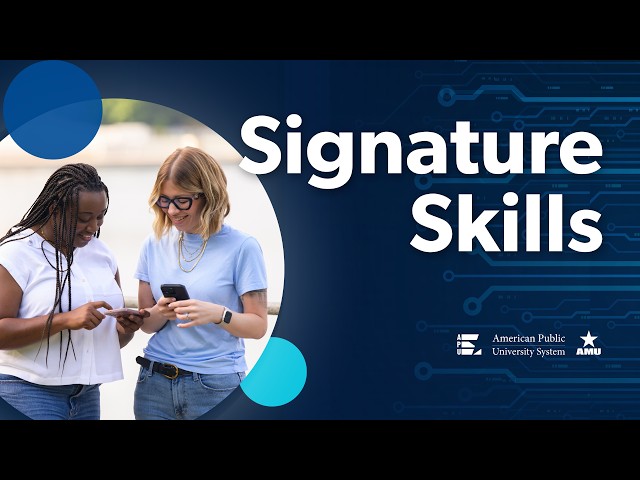
Welcome to a learning revolution.
APUS signature skills.
Digital literacy, critical thinking, a growth mindset entwine themselves around the student journey.
They’re in everything we do!
[Signature Skills homepage is shown]
Meant to inform our approach to you, and your ability to thrive beyond the classroom,
these signature skills teach you how to move through the world with confidence.
The road to success is paved with signature skills learned at APUS.
[APUS logo appears]
APU is here to support your student journey
We know your well-being is vital to your success. That's why we offer a range of supportive resources to help you throughout your academic journey.
- Career Coaching
- 24/7 Mental Health Support
- Admissions & Advising Support
- Student Life
Career Coaching
Get individualized guidance to help you explore career options, strengthen professional skills, and prepare for the next step in your journey. Whether you’re just entering the workforce, changing fields, or advancing your professional knowledge, our career services team is here to help you translate your goals into action.
Learn More24/7 Mental Health Support
Your well-being is essential to your success. That’s why APU offers access to confidential, flexible, and around-the-clock mental health support. Through our partnerships with telehealth apps, you can connect with peers and professionals anytime you need to manage stress, maintain balance, or find motivation.
Learn MoreAdmissions & Advising Support
From your first course to the day you graduate, our admissions and advising teams are here to guide you every step of the way. You’ll receive personalized assistance with enrollment, program selection, and degree planning from professionals who understand the needs of adult learners.
Learn MoreStudent Life
At APU, learning extends far beyond the classroom. Enrich your college experience and expand your network by getting involved in any of our student organizations. From cultural and social organizations to program-specific honor societies, you’ll find a group to help you thrive during and after your studies.
Learn MoreA Master’s in Public Health is Within Reach at APU
- $0 Application Fee
- $0 Textbooks & Ebooks
- $0 Transfer Credit Evaluation
Earning a degree is a valuable investment, but it needs to fit into your budget. Our tuition estimator can help you estimate your tuition and fees, so you can plan a manageable path to your educational goals. For full details, please refer to the financial aid cost of attendance (COA). This estimate does not include course materials, supplies, equipment, software and other expenses such as lab fees. You may be eligible for partnership grants through your employer. Speak with your admissions representative for more details.
APU Removes Barriers
Quality Education Shouldn’t Break the Bank
We offer special rates and grants for eligible students and limit fees to help keep the cost of higher education within reach. Find out how you can save on tuition expenses with our:
- Transfer Credits
- Financial Aid
- Private Loans & Scholarships
- Military & Veteran Benefits
Transfer Credits
APU makes it easy to earn credit for the work you’ve already done. We accept transfer credits from prior college coursework, professional training, exams, and certifications. We’ll evaluate your transcripts at no cost and help you maximize eligible credits so you can save time, reduce costs, and stay focused on reaching your education goals sooner.
Learn MoreFinancial Aid
We’re committed to making quality education accessible and affordable. APU participates in federal financial aid programs, including grants and loans for those who qualify. Our Financial Aid Office can provide personalized guidance to help you understand your options, complete required forms, and make an informed decision about paying for your education.
Learn MorePrivate Loans & Scholarships
In addition to federal financial aid, some APU students choose to explore private education loans or external scholarships to help fund their studies. We encourage all students to first complete the Free Application for Federal Student Aid (FAFSA) to determine eligibility for federal student aid before considering private options. Be sure to research lenders carefully, compare terms, and understand your rights and responsibilities as a borrower.
Learn MoreMilitary & Veterans Benefits
Learn More
Apply to APU’s Public Health Master’s Program Today
APU’s online MPH program is designed to accommodate busy working professionals. Our comprehensive curriculum includes online courses with no set login times. Students can work around their own schedules to complete weekly assignments and participate in weekly discussion forums.
The program also includes a 16-week practicum. Students gain real-world experience through hands-on learning in public health settings in their communities.
Review our admission requirements and submit your application today.
- No Entrance Exams No GRE® or GMAT®5 required for master’s programs
- No Application Fee For master’s-level courses
- Courses Start Monthly Enroll now, start next month
All APU master's degree and graduate certificate programs require a bachelor’s degree (or higher) from an institution whose accreditation is recognized by the Council for Higher Education Accreditation (CHEA).
In addition, the following documentation is required for admission into this program, and must be provided prior to course registration:
- Statement of Interest
Note
- Courses in this program are open only to students admitted to the program. These courses will not be available as electives in another program or for non-degree-seeking students.
- Please read all graduate admission requirements before applying to this program and be prepared to submit the required documentation including a legible copy of your valid government-issued photo ID (civilian students) or government-issued JST or CCAF transcript (military students).
- There is no fee to complete the APU admission application for this program. View steps to apply.
An APU admissions representative will contact you via email or phone to assist you with the enrollment process, review your documentation, and to notify you when you have been admitted into the program and may register for courses.
Learn More about Public Health Degree Programs and How Your Education Can Prepare You for Professional Opportunities
Yes. In 2017, APU became the first fully online institution to have its MPH program be accredited by the Council on Education for Public Health (CEPH). This accreditation has been reaffirmed through 2029.
APU’s MPH program meets the foundational competencies defined by CEPH and includes a 16-week practicum to provide learners with real-world experience and an integrative learning experience (ILE) that demonstrates synthesis of foundational and concentration competencies. The curriculum offers an in-depth study of emergency and disaster management, as well as effective quarantine practices. Graduates are also prepared to sit for the Certified Public Health (CPH) exam.
A master’s in public health can prepare you for meaningful, mission-driven work that directly impacts community health and well-being. MPH courses examine the leading research in epidemiology to help students understand the factors that influence public health policies.
Through APU’s CEPH-accredited MPH program, learners also meet nationally recognized professional standards. Coursework helps sharpen leadership, analytical, and communication skills, and graduates are eligible to sit for the Certified Public Health (CPH) exam.
An MPH degree is a professional degree that prepares learners to support public and community health promotion initiatives. MPH programs also examine how public officials, researchers, and healthcare professionals work collaboratively to protect communities against infectious diseases.
In APU’s online MPH program, students discuss everything from quarantine practices to emergency preparedness as they consider how to improve health outcomes within their communities.
Both degrees can lead to fulfilling public health careers, but the Master of Public Health is designed for students interested in addressing today’s public health challenges. MPH coursework provides a strong foundation in the five core disciplines of public health:
- Biostatistics
- Environmental health sciences
- Epidemiology
- Health policy and management
- Social and behavioral sciences
With more than 200 career-relevant degrees and certificates, APU makes online education accessible and affordable.


Request More Information
Interested in a specific program or wondering about the application process? Fill out the quick form below, and we’ll follow up with details tailored to your goals. Click here if you are a current student and need assistance.
Consumer Information
Maryland Residents learn more about costs, completion rates, median debt, and more.
The University reserves the right to accept or deny credits according to policies outlined on our University website. Please see the University's transfer credit policy webpage for complete information.
The Preferred Military Rate is $250 per credit hour for undergraduate and master's-level courses. This rate is available to all U.S. active-duty servicemembers, National Guard members, Reservists, and military families, including parents, spouses, legal partners, siblings, and dependents.
See all military student benefits.
